
Top 5 Manual Coffee Grinders in Japan | Selection Guide and Comparison
Top 5 Manual Coffee Grinders in Japan | Selection Guide and Comparison
Manual coffee grinders are quieter than electric models, more affordable, and highly portable—ideal for coffee lovers in Japan. However, they grind limited quantities at a time and are best suited for slowly enjoying one or two cups, so choosing based on popularity alone often leads to frustration.
Manual coffee grinders are quieter than electric models, more affordable, and highly portable—a compelling appeal for those in Japan seeking a quieter morning ritual. However, they grind limited quantities at a time and are best suited for slowly enjoying one or two cups, so choosing based on popularity alone often leads to a tool that feels awkward in actual use.
This article compares five models across three key axes—particle uniformity, burr material and cleaning ease, and capacity, weight, and portability—to help you find the right grinder whether you're buying your first one, planning to brew outdoors, or aiming to dial in your grind for maximum flavor. I've personally ground 12g for a single cup on weekdays and 24g for two cups on weekends, observing how ceramic and metal burrs affect fines and aftertaste.
The shortcut to choosing well is deciding your primary axis first, rather than chasing spec appeal. This guide organizes differences between beginner-friendly, travel-focused, and flavor-focused options with practical intent, and includes a quick-reference table and comparison chart so you can narrow down your choice on the spot.
Manual Coffee Grinders Are Right for These People
Manual grinders work best for those who want to grind one or two cups while enjoying the grinding process itself. Because they're quieter than electric models, you can use them even in the early morning hours when your household is still asleep—I often reach for a manual grinder on nights when I want freshly ground beans but want to avoid disturbing family with electric noise. The modest grinding sound alone is a practical advantage that's larger than you'd expect.
Another compatible scenario is camping or traveling while wanting fresh-ground coffee. Manual grinders are compact across the board; for example, the Porlex Mini II holds roughly 20–26g of beans, which at 12g per cup means one to two servings fit comfortably. At around 250g in weight, it easily tucks into a bag corner without adding burden, and the experience of quietly grinding beans on a camping morning becomes a treat in itself.
Price-wise, manual grinders also offer an approachable entry point. Beginner models are easy to find in the low thousands (USD equivalent: $30–50), and established options like the HARIO Ceramic Slim MSS-1TB—capable of holding 24g for two cups—remain affordable. Higher-end models offer sharper grind uniformity, but to first experience the flavor of beans ground immediately before brewing, a manual grinder has a lower barrier to entry than electric alternatives.
Important Caveats
While manual grinders suit certain people perfectly, they have clear limits in volume and time. Market-wide, maximum capacity hovers around 20g, and industry sources like UCC note that even a single cup can take 2–3 minutes. A single morning cup may pose no issue, but when brewing for two people at once, you'll fill the grinder completely and apply steady pressure, which demands a bit of arm strength.
Because of this, manual grinders suit people who brew carefully for themselves or up to two people rather than those regularly making three or more cups at once. For example, the HARIO MSS-1TB holds 24g, so at 12g per cup, that's exactly two servings. If you regularly exceed that, the grinding workload becomes tiresome, outweighing the appeal of quiet operation or portability.
People focused on flavor also notice that manual grinders are not all equal. Ceramic-burr entry models are easier to clean and simpler to start with, but if you want more uniform grinding and faster operation, metal-burr models like the TIMEMORE C3 or 1Zpresso J-Max have the advantage. From my own experience, when dialing in a light roast a touch finer, the uniformity of particles directly affects the clarity of the finish.
Choosing Ground Coffee Is Perfectly Reasonable
There's no need to force the ideal here. While freshly ground beans are preferable, buying pre-ground coffee on busy days is entirely rational. On mornings when ten minutes decide your whole day, adding 2–3 minutes of hand grinding isn't realistic.
I enjoy the aroma blooming as I grind on unhurried days, but I reach for pre-ground coffee when the schedule is tight—it fits my day's rhythm better. The key is not believing you must always grind from whole beans, but rather balancing flavor priorities with practical effort. A mix of hand-ground on weekends and pre-ground on weekdays is natural and keeps you from being ruled by your tools.
TIP
Switching to a manual grinder only on days when quiet operation matters is surprisingly practical. Hand-grinding at night or early morning, then using another method when time permits, reduces friction.
For a broad overview of manual grinder comparisons, the myBest manual coffee grinder popularity ranking organizes capacity, weight, and testing perspectives clearly. For an accessible introduction to how manual and electric grinders differ and how maintenance fits into usability, UCC's grinder guide is straightforward.
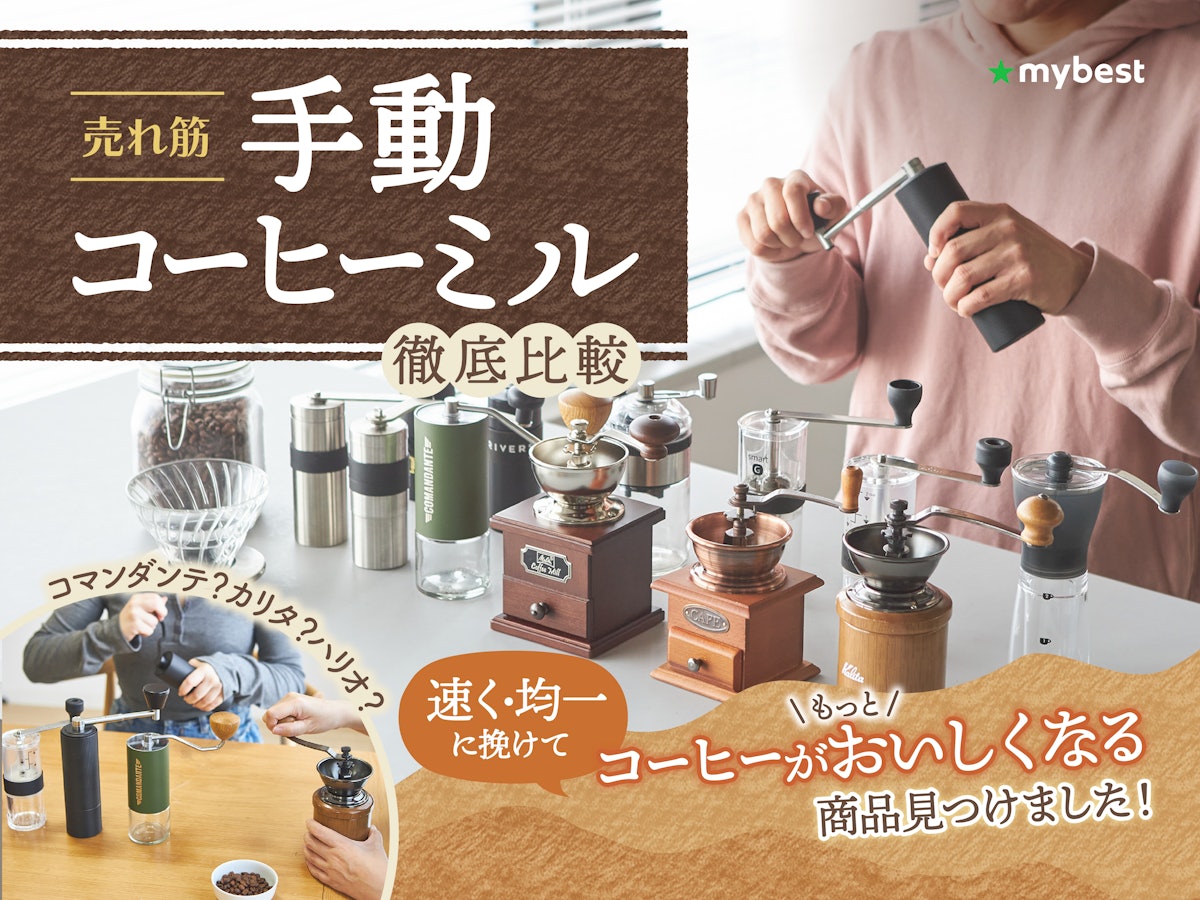
【徹底比較】手動コーヒーミルのおすすめ人気ランキング【2026年1月】
手動コーヒーミルは、コーヒーを丁寧にゆっくり淹れたい人におすすめのアイテム。自分でレバーを回して挽くことで、ゴリゴリという音とコーヒー豆を挽く感触を楽しめます。最近では、登山やキャンプなどのアウトドアで使うアイテムとしても人気。ハリオやカリ
my-best.comHow to Choose a Manual Coffee Grinder Without Failure
Burr Material: Ceramic vs. Metal
Burr material is often the first source of confusion when choosing a manual grinder. Broadly speaking, there are ceramic and metal burrs. For beginners, the mistake-resistant approach is to separately consider how far you want to dial in the flavor and how easy cleaning needs to be.
Ceramic burrs excel at being rust-resistant and simple to maintain. Standard models like the HARIO Ceramic Slim MSS-1TB and Porlex Mini II exemplify this category—they're entry-friendly precisely because cleaning is straightforward. Powder and oils rinse away easily, lowering the mental barrier to daily maintenance and encouraging consistent use.
Metal burrs, by contrast, typically offer sharper cutting edge, faster grinding, and more uniform particle distribution. Models like the TIMEMORE C3 series and 1Zpresso J-Max represent this tier, and grinding with metal burrs tends to deliver more stable extraction. When I grind 15g of the same beans through ceramic and metal burrs, the metal version flows more evenly during pour-over, and the flavor profile feels crisper—especially with light roasts dialed slightly finer, where the difference in aftertaste clarity becomes noticeable.
Here's what matters: "Material alone doesn't determine flavor." In reality, particle uniformity and fines distribution influence taste more directly. If you prioritize cleaning ease, ceramic makes sense; if you prioritize flavor consistency, metal is the better choice. Viewing it this way makes the decision clearer.
Particle Uniformity: How Fines and Distribution Affect Taste
A manual grinder's true measure comes down to how consistently it produces uniform particles. Even with identical beans, uneven grind size disrupts extraction progress, making each cup feel unpredictable.
What to observe here is fines and grind distribution. Excessive fines create bitter and astringent flavors as water channels through, plus they clog filter beds. Overly coarse particles, conversely, yield thin, acidic cups lacking sweetness. SOMA Coffee's explanation of grind size, fines, and distribution shows how dramatically uniform particles affect transparency and sweetness in the final cup.
For beginners, rather than chasing precise numbers, think about whether water flows steadily during extraction. Highly uniform grinders maintain consistent pour-over flow; you won't see sudden slowdowns or unexpectedly fast run-throughs with the same recipe. If flavor varies despite identical doses and water quantities, the mill's grind distribution deserves suspicion before blaming the beans.
If consistency is your priority, select entry-level models with strong uniformity ratings. The price difference is real, but extraction repeatability translates directly to satisfaction—this axis matters.
コーヒーミルの重要な仕事 – 挽き目・微粉・粒度分布 – SOMA COFFEE KYOTO
somacoffee.netGrind Adjustment: Step vs. Continuous, Internal vs. External Dial
Grind adjustment—seemingly a detail—carries real practical differences. First, separate step-based and continuous (free adjustment) methods.
Step-based grinders click into position, as with the HARIO MSS-1TB and TIMEMORE C3 series. The advantage is returning to yesterday's setting easily. For pour-over-focused beginners, repeatability matters, and this method lowers the confusion threshold. Trying different grinds one notch at a time lets you track change clearly.
Continuous grinders allow adjustment without detent steps, appealing to those wanting fine-tuning range. The 1Zpresso J-Max, for example, adjusts in 0.0088mm increments per click—a precision design for those pursuing exact specifications across applications, including espresso.
Dial position also affects usability. Internal dials sit near the burrs, simplifying mechanics but requiring near-disassembly for adjustment. External dials sit on the body's perimeter or top, letting you tweak settings between pours. If you regularly shift from light roasts (slightly finer) to dark (slightly coarser), an external dial provides considerably better convenience.
Grasping basic grind principles also helps. Finer grinds yield higher concentration and bitterness; coarser grinds feel lighter and cleaner. If your grinder's adjustment range is too coarse, hitting the sweet-spot sweetness band becomes difficult. Pour-over regulars often find step-based sufficient, but if you're pursuing flavor precision, adjustment fineness becomes worth evaluating to avoid missteps.
Capacity Guide: 10–15g Per Cup, 20g+ for Two or More Cups
Capacity matters more than its modest presence in spec sheets might suggest. Around 20g is standard in the manual grinder market, making it a useful reference point.
A typical single serving uses roughly 10–15g of beans. If you typically brew with 12g, a 20g-class grinder easily covers one cup with room to spare. One-to-two cup workflows fit comfortably within this range. For example, the HARIO MSS-1TB holds 24g, making it roughly two 12g servings—a balanced size for grinding just yourself one morning or preparing two cups for a couple on weekends.
If you regularly brew two or more cups, consider aiming for 20g+ capacity. Two cups might consume 24–30g, so smaller mills require interrupting to add more beans mid-session. Over time, this routine saps manual grinding's appeal considerably. The Porlex Mini II's roughly 20–26g tier works well for one person to two people outdoors, yet two full home cups might feel slightly tight.
Capacity isn't merely "volume that fits"—it's an indicator of how many cups you can grind without refilling. One cup? Small is fine. Two cups regularly? Aim for 20g+. Family-sized servings? Consider larger models. Matching this to your life simplifies the decision.
Weight and Portability: Sub-300g as a Travel Marker
For taking your grinder outside, weight matters before capacity. MyBest's 300g threshold serves as an intuitive baseline for portability.
The Porlex Mini II's roughly 250g feels comfortably light—smartphone-adjacent in heft. It tucks into a daypack corner without burden, pairing well with outdoor and travel use. When combined with its 20–26g capacity, "grind quietly and brew outdoors" feels naturally aligned.
The HARIO MSS-1TB's roughly 400g, by contrast, reads as best suited for kitchen placement rather than daily bag-carrying. Car travel or overnight trips pose no issue, but keeping it in a backpack full-time grants unwelcome presence. At roughly 775g, the 1Zpresso J-Max clearly prioritizes home bench use over portability.
Importantly, lighter doesn't mean unconditionally better. Ultralight models win on portability but may sacrifice stability or capacity. Heavier machines, while bench-bound, might excel at ease of grinding or precision dialing. Frequency of outdoor brewing versus home flavor refinement divides 300g nicely—think portability-centric below that, home-focused above.
Cleaning Ease: Brush Basics, Disassembly, Water-Washability, Parts Supply
Daily usability hinges on cleaning accessibility. Grinders hold powder and oils, so if cleanup feels like a chore, usage frequency drops.
Brush cleaning is your starting point. Rather than thorough rinsing every time, knocking out powder from around the burrs and the catch bin post-grinding prevents odor transfer and clogs. Disassembly ease then becomes the differentiator—grinders revealing clear structure let you access burrs and shafts readily, reducing cleaning friction.
Water-washability skews toward ceramic-burr models. The HARIO MSS-1TB disassembles for washing, a design that reassures beginners and keeps maintenance friction low. Ceramic models lighten the psychological load around cleaning, so you stay consistent with use. Metal-burr models typically rely on dry brush work, where leaving no dried powder matters more than frequency of cleaning.
Parts and replacement availability also merit review. Long-term, brands with steady supply chains (HARIO, Porlex) offer peace of mind. Handle, catch chamber, and internal component availability smooths the ownership experience.
TIP
"Washability" includes not just water-rinsing but also "is disassembly easy?" and "is reassembly straightforward?" When cleanup friction is low, the grinder gets used more often.
Top 5 Manual Coffee Grinders
By use case, these five machines have distinct personalities. Whether you want to quickly grind 12g for a solo morning cup, batch-grind for two on weekends, or dial in grind fineness precisely shapes satisfaction markedly. Here are five standouts organized around beginner-friendly, portable, flavor-focused, and precision axes.
HARIO Coffee Mill Ceramic Slim MSS-1TB
The HARIO Coffee Mill Ceramic Slim (model MSS-1TB) is the unfussy choice for a first purchase. MyBest lists it at ¥3,300 (approximately USD $22–25). Ceramic burrs, 24g capacity, step-wise grind adjustment. The disassemble-for-cleaning design is a major charm.
For you if hand-drip, French press, and coarser grinds align with your brewing. It prioritizes usability clarity over flavor finesse. Light roasts dialed tight won't dazzle, but medium-dark roasts shine with straightforward sweetness.
Worth noting: ceramic entry-models lag upper-tier models in speed and uniformity. Finer settings may feel sluggish mid-grind. At roughly 400g, it's a kitchen resident rather than a daily carry. Espresso capability isn't officially confirmed.
HARIO Coffee Mill Smart G
The HARIO Coffee Mill Smart G emphasizes portability within HARIO's range. HARIO's electric model EMSG-2B lists at ¥12,800 (roughly USD $85–90); the manual variant's pricing I'll leave unconfirmed here. Ceramic burr, step-adjustment, easy-disassembly structure.
The appeal lies in wanting to carry it—more than any spec. A quick morning single or a camp-site two-cup brew fits its character. Pocket-friendly size encourages daily grab-and-go. HARIO's disassemble-friendly design aids outdoor hand-washing.
Fits hand-drip, AeroPress, coarse-to-medium outdoor grinds. This light machine doesn't chase ultimate flavor; it values friction-free operation. That lightness, for 12g mornings, feels surprisingly freeing.
Caution: capacity remains unspecified, and routine two-cup batching strains its design. Uniformity and speed cede to upper models. Espresso compatibility unconfirmed.
PORLEX MINI COFFEE GRINDER II
The PORLEX Mini Grinder II stands as the gold standard for portable completeness. Price: ¥9,130 (roughly USD $60–65) via PORLEX official channels. Ceramic burr, roughly 20–26g capacity, step-adjustment via lower dial, Made in Japan.
About 20–26g holds roughly 1.6–2.2 cups (at 12g per serving), comfortably covering solo use and outdoor duos. At around 250g, it feels smartphone-weight; bagged carrying feels casual. The grind-fresh-on-the-go capability is formidable.
Suits drip, AeroPress, weekend travel cups. Finesse-wise, metal-burr upper-tiers win, yet this grinder's real magic is outboard brewing simplicity. Espresso capability isn't officially confirmed.
Caution: batching isn't its forte. Pre-ground office stashes may offset two-cup home grinds. Ceramic burrs mean hand-ease over grind-precision. This isn't a flavor-perfection machine; it's a go-anywhere confidence grinder.
TIMEMORE C3/C3S Pro Series
The TIMEMORE C3/C3S/C3S Pro series bridges "bean-crushing tool" into flavor-refinement equipment. Stainless burrs, ~36-step click adjustment, models up to 30g capacity. Pricing varies; I'll refrain from a fixed rate here.
This class reveals grind differences in pour-over vividly. Light roasts' bright acid, dark roasts' bitter contour—cleaner particle uniformity keeps flavor on-target. The clicky return-to-setting mechanic lets you repeat recipes without guessing. I find external-dial or easily-countable-step designs simplify recipe recall and bean-comparison work.
Suits drip-focused extraction. The appeal isn't espresso per se but elevating pour-over repeatability. When water temperature and pour feel consistent yet flavor wavers slightly, uniform particle scaling typically helps.
Caution: dry-brush maintenance edges out water-washing. Espresso capability isn't officially stated; frame it as a drip-focused grind-precision tool.
1Zpresso J-Max/K/Q Series
The 1Zpresso J-Max sits squarely in the upper-tier band. Titanium-coated stainless burrs, 35–40g capacity, roughly 775g weight. Click-adjustment: roughly 400 clicks total, ~90 per revolution, ~0.0088mm per click fineness.
The strength: hitting a target grind and returning to it reliably. Pour-over extracted in 30-second windows, espresso's ultra-sensitivity—this fineness pays dividends. Changing beans doesn't mean starting over; you ask how many clicks from last time. Weight signals home-bench presence, not portable companion.
Fits espresso-inclusive fine-grind and high-repeatability drip. Espresso compatibility feels front-and-center for this model. The caveat: overspecced for casual drip enthusiasts, yet goldmine-valuable for those chasing micro-grind mastery and flavor replication.
Side-by-Side Comparison Table
Seeing all five at once clarifies fit. Note weight and capacity especially—they divide "weekday single-cup," "weekend two-cup," and "travel-carry" visibly.
| Product | Price Range | Burr Type | Capacity | Weight & Portability | Grind Adjustment | Cleaning (Water-Safe, Disassembly) | Best For | Espresso-Ready |
|---|---|---|---|---|---|---|---|---|
| HARIO Ceramic Slim MSS-1TB | MyBest ¥3,300 (~$22) | Ceramic | 24g | ~400g. Feels kitchen-resident rather than bag-carry | Step-wise click | Disassembly-friendly, rinses well | First-timers, cleaning-prioritizers | Not confirmed |
| HARIO Smart G | HARIO NETSHOP electric at ¥12,800 (~$85) | Ceramic (manual) | Unspecified | Ultra-light, travel-inclined | Step-wise | Disassembly intuitive | HARIOists prioritizing portability | Unconfirmed |
| PORLEX Mini II | PORLEX official ¥9,130 (~$60) | Ceramic | ~20–26g | ~250g. Bag-friendly | Step-wise dial | Disassembly-prone, ceramic-easy | Travelers, campers | Not confirmed |
| TIMEMORE C3/C3S Pro | Variable pricing | Stainless | 30g models exist | Weight unspecified; balances portability and counter-staying | ~36-step click | Disassembly-leaning, dry-brush primary | Flavor-balance seekers, upgrade-from-entry buyers | Not officially stated |
| 1Zpresso J-Max | Higher price-tier, not fixed here | Titanium-coated stainless | 35–40g | ~775g. Home-bench tool, not travel companion | Precision click (0.0088mm steps) | Disassembly-prone, dry-brush-focus | Micro-dialing enthusiasts, espresso-explorers | Espresso-oriented |
Key takeaways from the table: The "just-right" entry is typically MSS-1TB's usability; portable perfection leans Porlex Mini II; flavor-repeatability balance hits TIMEMORE C3; grind-precision mastery belongs to J-Max. Smart G is HARIO's outdoor-first sibling.
Capacity carries weight—literally. The MSS-1TB at 24g splits two 12g servings neatly for weekend company. Porlex's 20–26g suffices solo-to-duo outings. J-Max's 35–40g handles two cups with breathing room and reflects upper-tier polish.
Weight reshapes frequency. Porlex at 250g earmarks travel duty; MSS-1TB suggests counter-keep; J-Max declares home-only work. Portability unlocks use patterns—lighter machines find their way into hands more often, boosting whole-bean enjoyment across your week.
Cleaning character diverges. Ceramic (HARIO, Porlex) shines rinsable, with water-friendly upkeep, while metal-burr models (TIMEMORE, 1Zpresso) thrive on brush-maintenance discipline—grind quality rises, but you pair that excellence with drier care routines.
TIP
Table-reading shortcut: scan weight → capacity → burr type in that order. Portability determines daily grab odds; capacity matches your typical brew count; then—and only then—compare ceramic gentleness against metal precision.
How Grind Fineness Shapes Taste: Manual Grinder Fundamentals
Core principle: Finer = more surface area = faster flavor extraction = stronger, more bitter; Coarser = gentler extraction = lighter, cleaner.
Grind Reference by Brewer
A safe entry: medium grind for paper pour-over, coarse for French press, medium-fine for AeroPress (recipe-dependent). Espresso demands extreme fineness, so HARIO Slim or Porlex Mini II (small ceramic machines) lose to TIMEMORE C3 or J-Max (grind-fineness-capable models) for hitting tight espresso windows.
Real-world tuning beats overthinking. If extraction is slow and aftertaste feels heavy/bitter, you're likely too fine; conversely, thin, sour flavor suggests too coarse. Shift one click at a time, watching both flow speed and cup. Fines build-up (gritty cup-bottom, sudden mid-drip clogging) usually means grinding overly fine for your beans; back off a notch and tweak your ratio instead.
Freshly Ground: Aroma and Peak Flavor
Whole beans trap aroma; grinding releases it. A manual grinder lets you lock that aromatic peak into your brew. Morning hand-turning releases nut, chocolate, citrus notes that pre-ground powder, exposed overnight, loses. A 12g fresh grind takes minutes—those minutes are flavor-capture time itself. SOMA and UCC both recognize this; your few minutes of turning become flavor-preservation work.
Turning Speed and Fineness Correlation
Rhythm beats rush. Grinding frantically bounces beans unevenly inside burrs, fragmenting intended particle size into chaotic fines. Steady, measured turning holds particle target. Especially as the hopper empties, resist the urge to speed up the final rotations—holding rhythm through the finish reduces aftertaste haziness and muddy notes. That discipline alone clarifies flavor noticeably.
TIP
Manual grinders reward consistent speed over raw power. Hold pace even as handle resistance shifts, and you'll notice extraction stabilizes and off-flavors fade.
These aren't high-end-only lessons. Even HARIO entry-models and Porlex travel grinders benefit from turning discipline. Set fineness correctly, preserve whole beans until brew-time, avoid rushing final rotations—these three habits curb manual-grinding pitfalls dramatically.
Cleaning and Maintenance Shape Flavor
Brush Cleaning Basics and Pitfalls
Manual grinders accumulate powder and oil residue with each session. Left unchecked, stale oils dull aroma and thicken flavor. I've watched a two-week accumulation dim a familiar bean's brightness, slowing extraction and muddying taste. A quick disassembly and brush sweep restores clarity—same beans, same pour, suddenly crisper.
Target every 10–20 cups or weekly. You needn't disassemble fully each time; brush the hopper, burr surround, and catch chamber interior dry. Mid-to-fine grind users or dark-roast brewers accumulate fines and oils faster, so edge toward shorter intervals here.
Avoid: blowing powder (moisture creeps in), damp-cloth wiping (powder clumps), hard tools on burrs (damage ensues). Basic: dry brush sweep—fails rarely.
TIP
Knock out loose powder right after grinding, then brush once. Preventing build-up beats heroic later cleaning.
Water-Washing Guideline
Ceramic burrs typically permit water rinses; the HARIO MSS-1TB and Porlex Mini II exemplify washable-design thinking. Metal-burr models (TIMEMORE, 1Zpresso) default to dry-brush use; internal water can shift bearing performance post-drying, changing grind feel.
Component-by-component judgment helps: catch chambers usually rinse fine; burr shafts need caution. Disassembly-friendly designs reveal water-safe zones clearly. Seals and bearings risk water entrapment, so when in doubt, consult the manual—each grinder differs.
Disassembly, Reassembly, Storage Protocol
Disassembly-friendly designs let you access buried powder deposits—blade backs, adjustment screw zones, shaft crevices—all unreachable from outside. HARIO and Porlex examples clarify this: remove parts, brush each, reassemble.
Safe steps:
- Empty the hopper
- Remove handle, catch bin, adjustment area, burr assembly in sequence
- Dry-brush each
- Rinse only water-safe components; air-dry thoroughly
- Reverse assembly order; return grind setting to previous position
Preserving your grind baseline matters. Re-guessing position drift on each clean sabotages repeatability. I jot down adjustment positions before disassembly so I recalibrate accurately afterward. Clean more confidently when you verify the setup returned to spec.
Storage keeps internals uncompromised. Post-grind, knock loose powder free, store in a low-humidity spot. Parts durability and availability also shape long-term joy—brands with supply chains win here.
Picking the Right Model: Decision Framework
Choosing a manual grinder starts clearer when you pre-sort your needs into four categories rather than diving straight into model comparisons. MyBest anchors 20g capacity and 300g weight threshold as key markers; UCC notes hand-grinding consumes 2–3 minutes per cup. Use-case clarity wins.
- One cup daily, or two or more?
Capacity speaks volumes. Roughly 10–15g per cup is standard, so 20g mills suit solo play, two cups approach the ceiling.
Porlex Mini II's 20–26g lands sweet for one-person-plus-guest scenarios. HARIO Slim's 24g equals two 12g servings—a zero-waste fit for two-cup mornings. When capacity feels just-short, daily friction accumulates; slightly-roomy capacity encourages habit.
- Home-only or travel-coupled?
Weight reshapes frequency. Below 300g invites backpack life; Porlex's ~250g whispers "let's go." Above 400g, think kitchen counter. At ~775g, the J-Max screams "stay put." MyBest's portability baseline rings true.
Light machines coax daily use upward—less friction at the grabbing stage multiplies sessions. Own experience: switching to a lightweight model for my solo cups nearly doubled grinding frequency.
- Drip-focused, or espresso eventually?
Pour-over alone? Ceramic or TIMEMORE C3 suffice; mood and preference guide choice. Espresso on the horizon? TIMEMORE's metal fineness helps; 1Zpresso J-Max's 0.0088mm clicks unlock that door fully. Dialing consistency trumps flash.
- Budget band = burr material + precision tier
¥3,000 ($22): Ceramic entry (MSS-1TB)
¥9,000–10,000 ($60–70): Portability polish or entry-to-upper jump (Porlex, TIMEMORE entry)
¥15,000+ (~$100+): Micro-adjustment mastery (1Zpresso J-Max)
Price rises, but spending targets shift: beginner accessibility → portable refinement → precision replication.
Quick-Reference Picker Table
Before diving into detailed specs, settle your use-case here:
| Your Use Case | Best Pick | Why | Watch Out |
|---|---|---|---|
| First manual grinder | HARIO Ceramic Slim | Two-cup capacity, disassembly-clean friendly, grasps core grinding | Weight suggests kitchen-stay, not daily carry |
| Travel/outdoor | PORLEX Mini II or HARIO Smart G | Compact, light enough to carry without burden | Don't overload with three-plus cups; both small-scale tools |
| Drip flavor-repeatability | TIMEMORE C3/C3S Pro | Metal grind-finesse, 36-step precision, taste difference visible | Dry-brush maintenance expected, not water-rinsing friendly |
| Espresso + grind-tuning | 1Zpresso J-Max | Micro-click control, high-precision, coffee-science leg |
Related Articles
8 Recommended Coffee Bean Online Retailers in Japan | Selection Guide and Comparison Table
Online coffee beans offer easy access to fresh, high-quality beans with wider selection than typical retail stores. However, with retailers ranging from Kaffee-Ya (with overwhelming inventory) to PostCoffee (with curated recommendations), beginners often struggle with deciding where and what to buy.
Best Home Espresso Machines: 6 Top Picks by Type
When choosing a home espresso machine in Japan, the least likely way to fail is dividing options into three types—fully automatic, semi-automatic, and capsule—then narrowing down to 6 models suited to your needs. Rather than chasing spec sheet numbers, start with 'How many minutes can I spend in the morning?' and 'How far do I want to build my latte?' Then the right machine for your lifestyle becomes much clearer.
Hario V60 Characteristics and Brewing Method | Why It's Popular and Basic Recipe
The Hario V60 remains a standard in Japan because its conical shape, single large hole, and spiral ribs transform the pouring method itself into flavor creation. The flexibility to brew either light and delicate or thick and sweet flavors makes it beloved in both home kitchens and professional coffee shops.
Top 5 Electric Coffee Grinders for Home Use in Japan | How to Choose & Compare
Choosing an electric coffee grinder based solely on grinding speed often leads to disappointment. For home use in Japan, satisfaction comes down to five factors: particle size consistency, noise level, how fine you can grind, ease of cleaning, and how many cups you can handle per session.