
How to Brew French Press and Choose Beans | 4-Minute Recipe
How to Brew French Press and Choose Beans | 4-Minute Recipe
French press is a brewing device with simpler steps than paper drip, yet it easily brings out the sweetness and body of the beans. It's especially well-suited for people who want to brew delicious coffee consistently even in the morning, or those who find pouring technique challenging.
French press is a brewing device with simpler steps than paper drip, yet it easily brings out the sweetness and body of the beans. It's especially well-suited for people who want to brew delicious coffee consistently even in the morning, or those who find pouring technique challenging.
In this guide, I'll examine the flavor characteristics unique to immersion brewing and how it differs from paper drip, then lay out a reproducible single-cup recipe with clear steps. I regularly compare the same beans between drip and press on weekday mornings, and I've found that press produces remarkably stable sweetness and body when conditions are consistent. The safest approach is to start with medium roast single-origin beans, medium to slightly coarse grind, 15g of grounds, 240–250ml of water at 92–94°C, steeped for about 4 minutes, then pressed slowly and poured immediately.
What Is French Press? Differences from Paper Drip
Extraction Method Differences
French press uses immersion brewing. Coffee grounds steep thoroughly in hot water, allowing components to extract over time, then a plunger with a metal filter pushes down to separate the grounds from the liquid. Paper drip, by contrast, is a percolation method where water passes through a layer of grounds as extraction occurs, then paper filters the liquid.
This fundamental difference directly shapes flavor. Because French press uses a metal filter rather than paper, coffee oils and fine particles pass through into the cup more readily. This results in a fuller outline and heavier liquid body with the same beans. Paper drip, being impermeable to oils, produces a lighter finish and cleaner, more refined flavor notes.
Historically, the patent leading to modern French press was obtained by Attilio Calimani in 1929, and "French press" became the common term. The basic extraction concept is simple structurally, but the philosophical difference between "retaining oils versus filtering them out" is quite significant—this is the essential distinction from paper drip.
Flavor Differences: Oil and Body vs Clarity
In one phrase, French press offers oil and body, while paper drip offers clarity. French press doesn't reach syrupy thickness, but produces a "silky" texture on the palate and aromatics that emerge with depth rather than just surface notes. UCC's guide on French press notes that the metal filter's ability to preserve the beans' natural oils is a key appeal.
Specific tendencies include: acidity feels rounder than with paper drip, bitterness emerges more readily but with softer edges. Sweetness rides alongside the liquid's weight, and body ranges from moderate to full. Aromatics carry an oily richness that paper filters would remove—even bright light roasts reveal the ripe sweetness beneath the fruit's surface, which is quite appealing.
Roast level creates significant variation, so bean characteristics are easiest to understand by comparing light versus dark roasts in context.
How to Brew French Press Deliciously
Coffee and Life. UCC COFFEE MAGAZINE
mystyle.ucc.co.jpStrengths and Weaknesses Reviewed Honestly
French press's main strength is simplicity and repeatability. Unlike drip, where pouring speed and technique shift flavor significantly, press follows a clear logic—add water and wait—making mornings more forgiving. Plus, because it extracts oils and fines, bean character stands out sharply. Origin differences, processing variations, and roasting refinement all become visible; good beans reveal rich information.
However, weaknesses are equally clear. First, grittiness and slight turbidity are inherent to the design. Those accustomed to paper drip's transparency sometimes find the mouthfeel heavy. Second, cleanup demands more effort. Paper filters make grounds disposal easy; press leaves oils on the filter and beaker walls, requiring thorough disassembly and washing. How carefully you clean affects how clearly the next cup's aromatics emerge.
Bean quality shows less mercy in press brewing. Beans that taste clean through drip sometimes reveal harshness or roasting imperfections in press. Conversely, when a bean's inherent appeal is strong, French press becomes genuinely eloquent. Think of it as an instrument that enlarges bean outline rather than creating flavor—this framing clarifies where press fits.
TIP
If drip "cleanly outlines aroma," press "lifts aroma and texture together." Brewing the same beans side-by-side illustrates this difference most clearly.
Equipment and Basic Recipe
Essential Gear and Helpful Tools
French press works with just the pot, but consistency improves considerably with a few additions: press pot, scale, kettle, grinder, timer, stirring spoon, and server. Beginners especially benefit from measuring over eyeballing.
Pot capacity matters, but grinder uniformity directly impacts extraction stability. Since press uses metal filters, inconsistent particle sizes lead to thin extraction from coarse particles and bitter harshness from fines. You needn't spend heavily, but reliable consistent grinding is flavor-critical.
Scale and timer ensure you reproduce 15g grounds, ~250ml water, and ~4-minute steep reliably. Because press minimizes technique variance, matching those three numbers alone produces good-tasting coffee. The kettle need not have a narrow spout, but a model you can pour from calmly helps.
A stirring spoon gently submerges grounds or levels the surface; metal works, but glass pots warrant caution. A server isn't essential but convenient—keeping brewed coffee in a warmed server lets you pour two cups without flavor collapse, making the second cup much more enjoyable.
Basic Recipe
Start with 15g beans, 240–250ml water at 92–94°C, steeped 4:00. The ratio of roughly 1:16.7 avoids extremes and easily produces French press's characteristic body and sweetness. Grind at medium to slightly coarse—imagine something between granulated sugar and coarse raw sugar.
This baseline appears across several reference recipes: Overview Coffee uses 15g/250ml/4:00; BALMUDA uses 17g/280ml/4:00; UCC suggests 12–13g/160ml for smaller cups. Despite numerical variation, ~4-minute steeping is nearly universal.
Water temperature sources cite 93–96°C generally, but 90–94°C proves easier for beginners. Medium roast pairs well with 92–94°C; lean slightly lower for softer brightness with light roasts, slightly higher for body with darker roasts. Stabilize at 92–94°C initially—fine-tuning comes later.
For those wanting slightly deeper flavor or extended sweetness, consider: 15g grounds / 250ml water / 90–92°C / ~5-minute steep, medium-leaning grind. This adjusts by using slightly finer grounds with lower temperature and longer time to emphasize thickness and sweetness (a practical adjustment rather than documented recipe). Uniform grinding remains essential to avoid grittiness.
Reference recipes worth comparing: UCC's 12–13g/160ml, Overview Coffee's 15g/250ml/4:00, BALMUDA's 17g/280ml/4:00, and PostCoffee's 4:00 with stirring. Rather than fixating on numbers, maintain ratio consistency, anchor around 4 minutes, and adjust slightly—this clarity matters most.
TIP
When the basic recipe seems thin, slightly refining the grind or extending steep by a minute preserves flavor better than simply adding grounds. Press impression shifts dramatically with grind-to-time combinations.
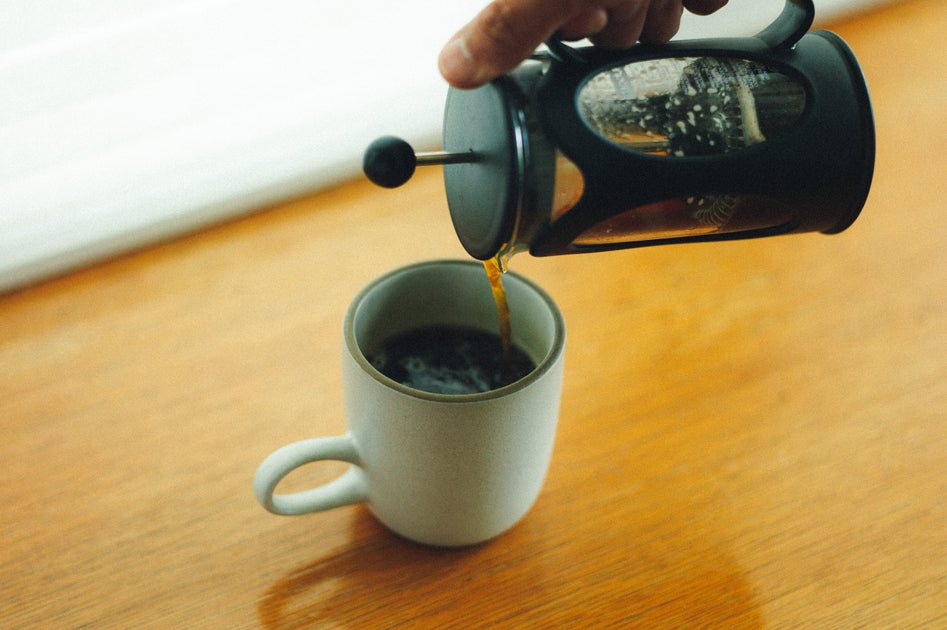
The Appeal of French Press
French press coffee tastes sweet and mellow—these balance characteristics define the experience.
overviewcoffee.jpStep-by-Step Instructions and Tips
Steps are straightforward, but key points ensure consistency: preheat → full pour → light stir or brief bloom if desired → steep ~4 minutes → slow press → immediate pour.
-
Warm the press pot and server (if using) with hot water. Cold equipment drops temperature and dulls flavor.
-
Add 15g grounds, pour 240–250ml water at 92–94°C. Pouring technique matters less than with drip; prioritize fully wetting all grounds.
-
If dry grounds remain on the surface, stir lightly 1–2 times. Alternatively, pour a small amount first, let it bloom briefly, then add the rest. Bloom is optional but helpful for flavor.
-
Wait ~4 minutes. If foam accumulates visibly, gently skim it away for cleaner texture.
-
Press slowly over tens of seconds without rushing. Aggressive pressing churns up fines, causing turbidity and off-flavors.
-
Immediately pour into cups or a server. Leaving liquid in contact with grounds continues extraction, making later pours heavier.
This routine prevents bitter surprises. Even on hectic mornings, these three points—waiting, slow pressing, and immediate pouring—anchor consistency.
Capacity Selection (350ml/500ml/1L)
Choose by how many cups and when you brew: 350ml suits solo, 500ml works for ~two cups, 1L is too large for everyday use. Against the ~250ml single-cup recipe, 350ml offers comfort solo, 500ml lets you brew two cups at once at home conveniently.
350ml is portable and unobtrusive; Bodum Chambord 0.35L costs roughly ¥3,960. The weight feels substantial despite the modest size—perfectly manageable for one person.
500ml is where daily satisfaction peaks. I use this size often, brewing two cups in the morning and enjoying consistency without repeating the process. 1L models suit guests or batch brewing but feel oversized and cumbersome for routine use.
Your bean preferences also matter. Because French press amplifies bean character, medium-roast-focused brewing suits 500ml for two cups; exploring light roasts in small quantities suggests 350ml. This coherence between capacity and bean direction streamlines decisions.
Selecting Beans for French Press
Guidance by Preference (Acidity/Bitterness/Balance)
Because French press retains oils and fines, bean character emerges clearly. Start with single-origin (straight) beans to sense differences—blends prioritize drinkability, but learning preference requires single origins' transparency. This parallels existing discussions of single-origin vs blend distinctions.
For acidity-focused preference, light to medium roasts with brightness appeal. Ethiopian beans displaying berry and floral notes especially shine in press—the aromatic layers expand richly, with blueberry and jasmine nuances emerging naturally. Light roasts seem intimidating but are actually forgiving in press since pouring technique barely affects them, making them accessible as an entry point to aroma exploration.
For bitterness and body emphasis, medium-dark through dark roasts speak clearly. Brazilian and Colombian beans in these ranges reveal chocolate, roasted nut, and molasses depth that mesh beautifully with press oils. I've compared the same Brazilian lot at City and Full City roasts; Full City showed black-sugar sweetness and roasted-nut texture intensify markedly, remaining robust even with milk.
For those uncertain, medium to medium-dark roasts prove safest—they're never tiring and neither acidity, sweetness, nor bitterness dominates. This middle zone remains user-friendly for bean selection reasoning as well.
TIP
Uncertain about French press bean selection? Start with one medium-roast single-origin, then add one medium-dark single-origin. This reveals whether you chase "aroma" or "body"—clarifying future purchases.
Origin Flavor Guidelines
Region isn't about hierarchy but flavor-tendency patterns. French press makes origin character obvious, explaining why single-origin pairing works well. Roughly: Ethiopia = bright, Brazil = sweet-toasted, Colombia = balanced-approachable.
| Origin | Acidity | Bitterness | Sweetness | Body | Aroma |
|---|---|---|---|---|---|
| Ethiopia | High | Low–Medium | Medium–High | Light–Medium | Exceptionally Bright |
| Colombia | Medium | Medium | Medium | Medium | Well-Balanced |
| Brazil | Low–Medium | Medium–High | High | High | Nut/Chocolate Notes |
| Guatemala | Medium | Medium | Medium | Medium–High | Dimensional |
| Kenya | High | Medium | Medium | Medium | Vivid Berry |
Ethiopia, roasted light to medium, brightens pleasantly. Press adds liquid thickness, so acidity reads as ripe-berry sweetness rather than tartness—a compelling pairing. Brazil, from medium roast onward, stabilizes nut, cocoa, and grain-based sweetness that suits press's roundness perfectly.
Colombia sits between, with balanced acid, sweetness, and body—an accessible starting region. Origin selection clarity from existing coffee bean origin comparison guides applies, but press amplifies these differences noticeably.
Roast Level and Press Compatibility
Roast degree significantly shapes press impression. The instrument's nature preserves light beans as light, deep beans as deep—no disguising. Therefore, medium to dark roasts prove most approachable as entry points. Medium offers balanced sweetness and aroma; dark emphasizes body and bitterness clearly.
Light roasts, however, aren't incompatible. Light Ethiopia or Kenya in press diffuses berry and floral aromatics in oily abundance, yielding a glossy quality distinct from drip's transparency. While transparency favors drip, aroma quantity favors press.
Roast-degree tendencies simplify as:
| Roast | Acidity | Bitterness | Sweetness | Body | Aroma Traits |
|---|---|---|---|---|---|
| Light | High | Low | Medium | Light | Berry, Citrus, Floral |
| Medium | Medium | Medium | Medium–High | Medium | Well-Balanced Notes |
| Medium-Dark | Low–Medium | Medium–High | High | High | Chocolate, Nut, Molasses |
| Dark | Low | High | Medium | Very High | Roast Aroma, Bitter |
This framework connects to roast-level comparison discussions, with press introducing an additional layer: same roast-level beans taste subtly different by grind variation. Medium grind emphasizes sweetness and intensity; coarse mutes grittiness. Beginners benefit from medium-to-slightly-coarse as baseline, with light roasts leaning medium-grind for aroma and medium-dark leaning coarse for texture refinement.
Processing Method (Natural/Washed/Honey) Differences
Beyond origin and roast, processing deepens bean-selection literacy, and press reveals these distinctions clearly.
Natural processing advances fruit and sweetness. Press extraction loads ripe-berry and dried-fruit thickness generously, with lush aroma. Natural Ethiopia becomes striking in press—aroma brightness appeals strongly to those chasing aromatic emphasis.
Washed processing offers clarity and outline. Press favors texture over transparency, yet washed beans show flavor lines distinctly within that thickness, making "what am I tasting?" legible. Colombian or Guatemalan washed beans reveal sweetness-acidity positioning clearly—excellent for learning bean character.
Honey processing occupies the middle ground—fruitiness gentler than natural, not as defined as washed, with yielding sweetness. Press extraction casts this as caramel or yellow-peach viscosity, suiting those seeking rounded mouthfeel.
Processing awareness sharpens when considered with origin and roast together: Ethiopian light-roast natural = bright fruit; Colombian medium-roast washed = refined sweetness; Brazilian medium-dark honey = thick sweet-bitter character. This combinatorial thinking makes press bean selection richly dimensional.
Flavor Building by Preference
Five Taste Elements and Four Adjustment Variables
French press flavor-building follows acidity, bitterness, sweetness, body, aroma adjusted via grind, water temperature, time, and bean amount. Immersion's minimal technique variance means changes appear directly in the cup, enabling precise reproducible targeting.
Grind size matters most. One step finer increases thickness, sweetness, and extraction feel. Mouthfeel densifies; fruit's sweet-sour character reads as "sweetened acidity." Fines rise, though, increasing grittiness. One step coarser lightens texture and pushes finish toward clarity. Adjusting grind alone noticeably shifts mouthfeel and sweetness before aroma shifts—identify your "gritty threshold," and later refinements become manageable.
Water temperature controls acid and bitter expression. Higher heat advances component extraction, boosting body and bitterness; lower heat softens edges and rounds aroma. Sometimes lowering temperature slightly on light roasts rounds outline beautifully despite sacrificing some brightness. Dropping temperature by 2°C shifts aftertaste dramatically.
Time governs extraction completeness. Longer steeps deepen concentration and bitterness; shorter steeps preserve lightness and brightness. However, extending time alone invites off-flavors, so combining fine grind with longer time requires slight temperature reduction for balance.
Bean amount sets concentration and structure. Even 1g more rescues thinness. Yet adding beans boosts bitterness and weight alongside sweetness, so distinguish whether you want richness or pure density increase. Density matters in a separate discussion (see dilute vs concentrated coffee adjustment), but practically, weight addition intensifies everything.
Coarse-grind recipes reduce grittiness through safety; medium-grind recipes pursue sweetness-intensity more aggressively. Both work—preference and tolerance determine choice. Pursuing medium-grind sweetness pairs well with longer steep + slightly lower temperature for thickness without harshness.
French Press Extraction Time Matters
Brew Great Coffee at Home - THE COFFEESHOP
thecoffeeshop.jpProblem-Solving Adjustment Guide
Flavor troubles narrow when framed as "what's excessive" or "what's missing"—this focus sharpens variable selection. Press tempts you to tweak everything; symptom-based priority makes decisions clear.
Sharp acidity usually signals underextraction. Move temperature down 1–2°C, shorten steep 15–30 seconds, or coarsen one grind step. Conventional extraction theory might suggest the opposite, but press's fines and light-roast brightness can read as "sour," solvable by these moves. Bright beans with biting acid often soften magically with slight cooling, the berry reading as "sweetened acidity."
Bitterness means overextraction. Answers are clear: lower temperature, coarsen grind, shorten time—in that order. Avoiding instant bean-amount cuts prevents thinning alongside bitterness reduction.
Thinness lacks flavor core. Three straightforward fixes: fine grind one step, add 1g beans, or extend steep 15–30 seconds. Light-tasting-but-not-thin = grind; density alone missing = beans; depth failing = time. I typically test grind-fining first to see if sweetness expands, adding beans if that's insufficient—this reading-changes approach builds sensitivity.
Grittiness exceeds acceptable oiliness. Coarsen one grind step immediately. Additionally, skip the final pour's bottom portion—accumulated fines there reduce noticeably. Remove surface foam with a spoon for cleaner feel. These textures compound, so address multiple points.
TIP
Map trouble to causes: "sour = temperature/time," "bitter = temperature/time/grind," "thin = grind/beans," "gritty = grind + pour discipline." This taxonomy prevents wild adjusting.
"Single-Variable Experiment" Testing Approach
The quickest path to personal preference: change one variable per brew. Suddenly cause-effect becomes visible. After a baseline cup, brew again adjusting grind alone. Next attempt adjusts temperature alone, then time alone. When sensitivity is low, grind → temperature → time → beans order reveals difference most readily—grind shapes mouthfeel and sweetness; temperature controls angles; time advances concentration; beans set strength.
My frequent practice: brew two consecutive cups, adjusting a single element between them. Comparing medium-leaning vs slightly-coarse-leaning reveals thickness and aftertaste clarity differences before aroma impressions emerge. This tells you whether you prioritize sweetness or crispness—once clear, temperature and time adjustments become intuitive.
Those favoring medium-grind sweetness might explore slightly finer grind + longer steep + slightly lower temperature. Coarse-grind enthusiasts profit from measured time and aftertaste clarity. Both approaches succeed; intent differs. Press's advantage is that both philosophies stay legible side-by-side, sharpening tasting skill.
Does French Press Need Blooming? Brew Tips for Better Coffee - THE COFFEESHOP
Review your French press recipe. THE COFFEESHOP explores specialty coffee extraction methods.
thecoffeeshop.jpCommon Mistakes and Solutions
Suppressing Grittiness and Turbidity
The most frequent issue: mouthfeel grittiness and cup turbidity. This reflects press's fine-particle permeability rather than design failure—solutions are clear. Coarsening grind one step helps first. Medium-leaning recipes pursuing sweetness attract grit; resisting density temptation in favor of texture usually works better initially.
End-of-extraction handling matters significantly. When pouring, avoid emptying completely—leave bottom sediment (strong turbidity concentration) behind. Press naturally collects fines lower; discarding final sips refines taste without real loss.
Skim floating foam and fine powder with a spoon—liquid clears, mouthfeel brightens. Texture impression transforms.
Press slowly, not forcefully. Speed churns suspended matter airborne, muddying settled grounds.
Sourcing and Isolating Off-Flavors, Harshness
Flavor-roughness ("bitter" versus actual grainy/harsh astringency in mouth corners) needs careful diagnosis. Three factors typically combine: temperature too high, steep too long, grind too fine. Deep roasts especially show astringency when over-extracted—sweetness vanishes, leaving harsh residue. Lower temperature first to soften angles; it controls sharpness better than grounds-manipulation.
If lingering dryness remains post-swallow, shorten steep, then coarsen sequentially. Identifying where extraction went too far clarifies future recipes.
Harshness often falsely blames bean quality; actually it frequently reflects extraction conditions. Beans tasting clean through drip sometimes reveal harshness in press—adjust temperature or time, not expectation.
Solutions for Thin-Tasting Coffee and Plunger Resistance
Thin flavor suggests insufficient extraction: grind too coarse, beans too few, or steep too short. Bland-but-not-sharp = coarseness; bland-with-preserved-aroma = bean count; thin without aftertaste = time. Compare these, adjusting one per attempt.
Uneven particle size worsens thinness: coarse particles extract lightly; fine ones stagnate. "Thick in one spot, thin elsewhere" points to grind uniformity failure. Refining grind before adding beans often clarifies thinness better than simple quantity increases.
Difficult plunging clearly indicates resistance increase, most commonly from grind fineness or excess beans. Fine particles clog filter face; accumulated pressure builds. Force risks internal chaos and fines re-suspension—avoid it. Instead, press steadily; clogging from ultra-fine or excessive amounts needs correction, not strength.
Unusual resistance sometimes signals filter warping or misalignment, visible on inspection. Post-extraction gas buildup occasionally creates pressure sensation; gentle persistent pressing releases it harmlessly.
TIP
"Thin" = insufficient extraction targets; "hard plunge" = physical resistance. Distinguishing these prevents addressing wrong problem.
The Critical "Don't Linger" Rule
After plunging, extraction doesn't fully stop. Liquid remains in contact with grounds through metal filters, causing ongoing fines overextraction. Thus, immediately pour into cups or server; don't leave the pot sitting.
This difference astonishes. Leaving pressed coffee in-pot for 5 minutes visibly degraded samples I've tested—sharp bitterness and heavy flatness emerge noticeably. Early sips stay acceptable; cooled liquid separates dramatically. Medium-grind or fine-particle recipes especially suffer; sweetness surrenders to dull bitterness.
Multi-cup brewing heightens this need. In-pot residue means cup 1 and cup 2 taste differently—press's key strength (reproducibility) collapses. Immediate pouring locks flavor in place; it's not convenience, it's taste preservation.
Why Avoid Dual-Use (Coffee and Tea)
Press shape tempts dual-use with tea, but flavor-purity argues against it. Coffee oils and aroma persist in equipment, especially metal filters and plunger crevices. Residue transfers easily to subsequent brews, muddying them.
Tea aromatics are delicate; coffee residue's oily weight and roast-notes dirty impressions immediately. Reverse compatibility fails similarly—tea oils linger, affecting coffee's intended character. Structural recesses retain scent stubbornly despite apparent cleanliness; plunger-rim and mesh interfaces hide traces persistently.
This aligns with discussions in Kee Coffee's French press guide, yet hands-on experience confirms it beyond theory: flavor purity demands dedicated use. Since press excels at revealing bean individuality, tolerating competing aromatics defeats its purpose. Separate equipment ensures authentic flavor expression.

Does French Press Work at Home? Delicious Coffee Brewing Tips - Kee Coffee
Learn how French press extraction works, its flavor appeal, and home-brewing tips for success.
keycoffee.co.jpMaintenance and Longevity
Disassembly-Washing Procedure
Press design looks simple; actually, mesh, shaft, and lid-rim harbor coffee oils and fines readily. Quick rinsing alone dulls next-cup aromatics and stiffens plunger feel. After brewing, discard grounds and wash immediately. Oils harden over time, scent entrenches, and resilience suffers.
Disassemble completely: lid, shaft, and mesh separate. This seems inconvenient but remains essential—skipping allows grit accumulation. Mesh edge-gaps and lid-underside crevices trap fines; seemingly clean equipment degrading flavor is common.
Warm water with neutral dish soap dissolves oil residue. Glass vessels and inner surfaces deserve thorough scrubbing past liquid marks. Brush reaches crevices, mesh gaps, and threads where fines hide. I increased mesh deep-cleaning frequency weekly, noticing subsequently that aromatics—especially light-roast floral brightness—emerged cleaner. Previously obscured clarity became visible.
BUCKLE COFFEE's washing guide emphasizes disassembly-washing as standard, not optional. Honestly, it's not complicated work—oily residue avoidance equals taste maintenance. After soap, thorough rinsing removes foam completely, especially in assembly seams. Full drying before re-assembly matters; moisture left behind invites scent issues.
TIP
Closing the lid and shaking water inside doesn't reach mesh internals or shaft crevices. Complete disassembly prevents "looks clean, tastes off" situations—make it routine.
Oil Residue and Odor Care
Press's appeal—oil-forward mouthfeel—creates a maintenance flip side: retained equipment oils turn rancid. Oxidized residue emerges as stale-nut heaviness or muffled mustiness in subsequent brews. Deep-roast sequences especially obscure accumulation; flavor dulls silently.
Daily thorough washing with dish soap significantly helps. Soap-assisted oil removal rather than water-only rinsing prevents lingering funk. Soap scent itself dissipates with careful rinsing; mesh and gasket thorough flushing ensures safety.
Persistent odor responds to periodic warm-soapy soak-washing. Stronger cases benefit from oxygen-based cleaner short-term soaks (manufacturer instructions essential—plastic or plated components risk damage if oversteeped; metal-only approach requires care).
Odor-prevention emphasizes post-brew-immediate cleaning and prompt drying before storage. Liquid lingering in grooves ferments scents. Complete drying halts mold-risk and trapped aromas entirely.
Worn Parts and Replacement Timing
Persistent odor despite careful washing, changed plunger feel, or sudden fines increase suggest component degradation, not cleaning failure. Mesh, gaskets, and mobile shaft portions degrade readily. Metal mesh warping or bending weakens seal; fines escape.
Gaskets absorb and retain oily scent stubbornly. Washing sometimes fails to fully dislodge embedded aroma, at which point replacement refreshes both odor and performance. Mesh edge-lifting or plunging-catch sensations signal functional compromise. Extraction becomes inconsistent; transparency suffers.
I suspect component degradation first when pre-well-adjusted brews suddenly feel flat or clouded—new mesh often restores brilliance immediately. Clean light roasts' flower-like delicacy or acid-clarity—easily buried by aged equipment—re-emerge sharply post-replacement. Press amplifies component condition heavily.
Replaced parts last longer with faithful post-brew-immediate washing, full disassembly, thorough rinsing, and complete drying practices. French press's low-maintenance reputation partly misleads—it demands consistent care for durable performance, but that care pays richly in stable flavor.
Summary: Your First Cup with Recommended Starting Combination
French press rewards fixing a baseline and observing variations over chasing early perfection. I typically anchor weekdays to a basic recipe, comparing a single variable—origin, roast, or processing—weekends. This builds both reproducibility and the pleasure of bean discovery without tension. Immediate post-brew pouring and cleanup completion form a unified rhythm; next-cup flavor clarity follows naturally.
Related Articles
How to Make Iced Coffee Compared|Quick-Chill, Cold Brew, and Ice Drip Methods
Once you grasp the differences between quick-chill, cold brew, and ice drip methods, iced coffee becomes far less confusing. Whether you prioritize brightness and aroma, prefer soft sweetness, or want to savor the extraction process itself, your choice of method will shape the entire experience—and we'll walk you through each one with reproducible recipes and troubleshooting tips for making iced coffee in Japan.
Hand-Drip Coffee: Master the Basics with a Simple Recipe and Pro Tips
When hand-drip brewing feels unstable, pinning down your numbers before relying on intuition is the fastest path to improvement. This guide, designed for beginners wanting to recreate a delicious cup at home and for regular brewers looking to refine their daily ritual, centers on a benchmark recipe of 15g beans, 240ml water, 92°C, and about 3 minutes (medium grind, 30-40 second bloom) as a starting point for systematic adjustments.
Espresso Extraction Basics and Adjustment Techniques | Home Brewing Stability Guide
Home espresso becomes much more stable simply by establishing one baseline recipe first, rather than adding complex theory. This guide uses the fundamental 1:2 ratio recipe (e.g., 18g→36g, 25–30 seconds, 90–96°C) as a foundation, then walks you through which variables to adjust based on taste, getting you to reliable results the fastest way.
How Long Should You Bloom Drip Coffee? Start With 30 Seconds
When hand-drip coffee tastes inconsistent, the bloom time is often worth reconsidering. This guide breaks down the differences between 20, 30, 40, and 60 seconds from a practical perspective—useful for beginners wondering how long to bloom and for those seeking finer control over acidity, sweetness, and body.